BI Beat: Tools for Compliance: Work Search Log
The BI Beat is a monthly newsletter column written by the Behavioral Insights team, featuring insights, practical examples and interviews from the field. Today’s piece continues our ongoing series, “Tools for Compliance.” Provided in partnership with the U.S. Department of Labor.
It’s fun to complain about paperwork—try asking a nurse, police officer, or a taxpayer at your next dinner party. Red tape has a magical way of sapping our energy. Behavioral and cognitive scientists have done a great deal of work to map out how we exhaust our limited energy (“cognitive bandwidth”) with unnecessary paperwork (“sludge”). Conclusion: paperwork is a drag.
And yet, of course, we need medical records, police reports, and tax filings.
As Mary Poppins might sing, this is a “spoonful of sugar” kind of problem. We need the medicine, but can we perhaps make it less bitter? One simple trick is to make the red tape as simple as possible.
The Fatigue of Reporting Work Search
For unemployment insurance (UI) claimants, work search is a unique “paperwork experience”, given the requirement for claimants to maintain evidence that they’re looking for work. Indeed, asking for proof may motivate some claimants to apply for more jobs and find work earlier—an ideal outcome for claimants, taxpayers and employers.
That said, work search reporting can be frustrating to claimants. Job seekers live in a fatigued state—from the job search itself, as well as facing rejections from potential employers and daily stress exacerbated by financial strain. Rather than using all of their energy on their job hunt, claimants must sift through the rules of “qualified work search activities,” figure out what to report, and decide how to retain documentation.
To make sure we’re not unnecessarily slowing down dedicated job seekers, work search descriptions, procedures, and tools should be as simple as possible.
NASWA BI's Work Search Log
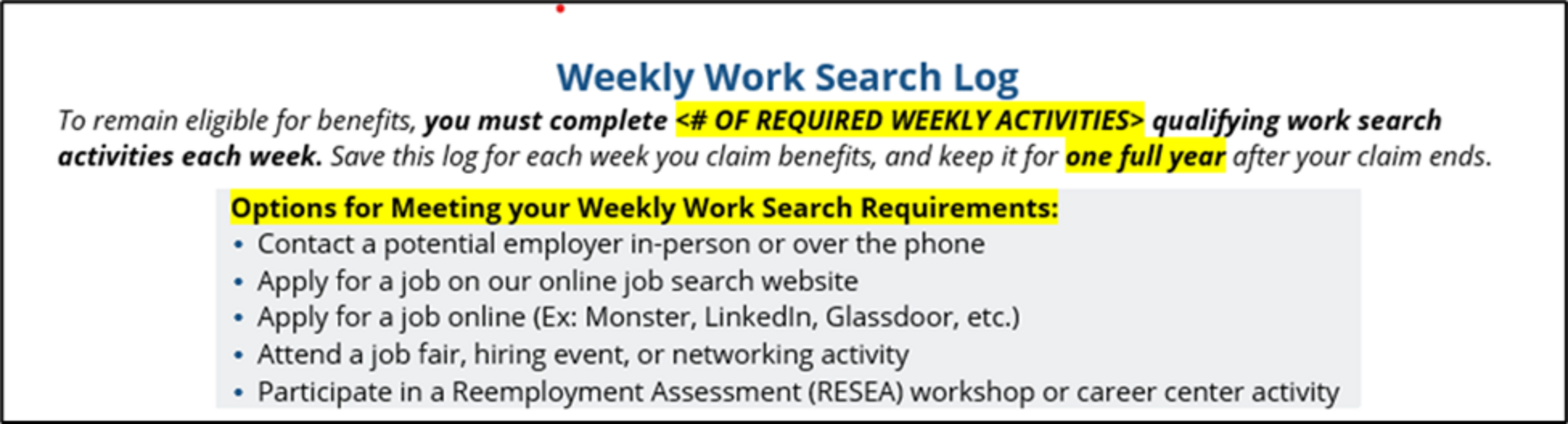
NASWA BI created a Work Search Log that not only provides a place for claimants to take notes on their work searches, but also doubles as a cheat sheet for claimants on the entire work search process. The Work Search Log is divided into three sections, each of which has an important function:
1. A simple introduction to present the rules
First, we give claimants a simple list of:
- How many activities they need to do
- Documents they need to keep
- A list of acceptable work search activity options
Primarily, this section takes advantage of the concept of “simplification”—we’re more likely to engage with things that we can easily wrap our minds around.
2. A worksheet to gather all required information
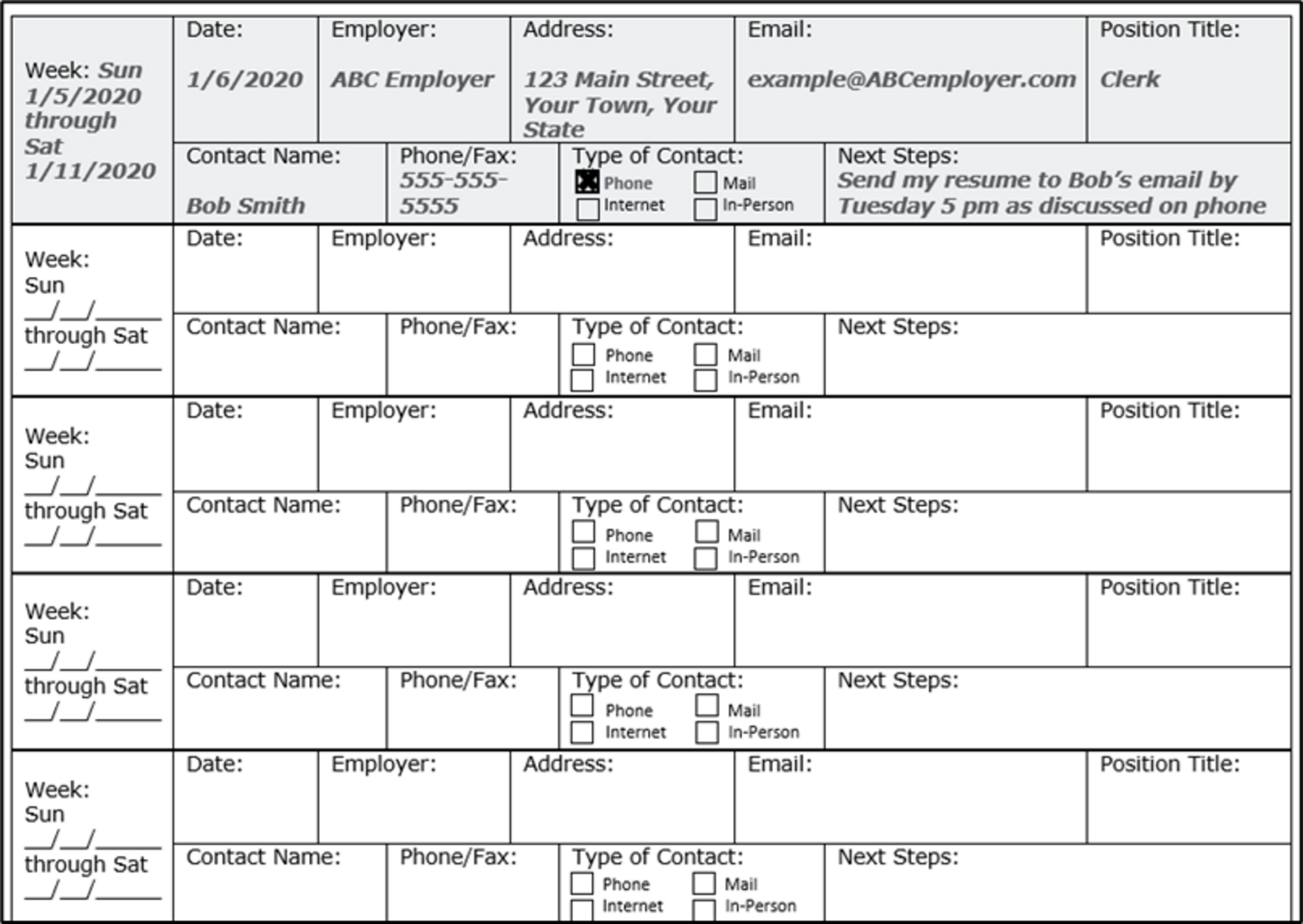
Much research has been done on the value of checklists—and not surprisingly, consistent use of checklists helps us remember things. It’s one thing to ask a claimant to record their work searches in case of audit, and quite another to specifically prompt them for specific, critical information, including:
- Dates
- Employer Names
- Addresses
- Emails
- Position Title
- Contact Information
- Follow-up details
Rather than having claimants think about the information they need, the worksheet prompts them to gather everything a BAM investigator needs.
3. A concluding call-out for soft encouragement
Repeated rejections during job searches are discouraging. Ending with some professional encouragement can be motivating.
Here, we remind people that their struggles finding a job are not an indication of failure, but rather an indication that it’s a difficult task—and the only way through is to keep applying. This takes advantage of insights from motivation theory.

Conclusion
NASWA BI is happy to work with you to create a similar work search log in line with your state’s branding and regulations. With a cheat sheet in hand, claimants will need to spend less time understanding and reporting work searches, and instead focus on the meaningful task of searching for work. Better informed, claimants are also less likely to make mistakes that result in work search errors.

If you are interested in simplifying the online claimant experience, NASWA BI can help. Reach out to us at integrity@naswa.org to learn more.
*A NASWA member login is required to access some Library resources. Watch this video for help.
This project is funded by the U.S. Department of Labor and administered by NASWA.