BI Beat - Tools for Compliance: Why Expiring Work Search Waivers are like an Exercise Routine
The BI Beat is a monthly newsletter column written by the Behavioral Insights team, featuring insights, practical examples and interviews from the field. Today’s piece continues our ongoing series, “Tools for Compliance.” Provided in partnership with the U.S. Department of Labor.
Introducing an Uncomfortable Habit
Here’s your actual morning:
Wake up, get dressed, brush your teeth, eat breakfast, and drive to work.
Here’s the morning you want:
Wake up, exercise, get dressed, brush your teeth, eat breakfast, and drive to work.
There are many reasons that exercise can be difficult. It is uncomfortable, it takes time, it makes you sweat, it is boring, and so on. Another important reason exercise can be difficult is the extra effort it takes to build a new routine. You may have had the same morning rituals for a long time, so suddenly crunching in some sit-ups—even if they’re good for your long-term health—can be challenging.
Overcoming Work Search Waivers
The same psychological logic holds for claimants who have been filing weekly claims but have had a waiver from work search activities. Suddenly crunching in some work search activities—even if it’s good for claimants’ long-term financial health—can be challenging. A few years ago, BI put together a brief to help state workforce agencies communicate with those claimants.
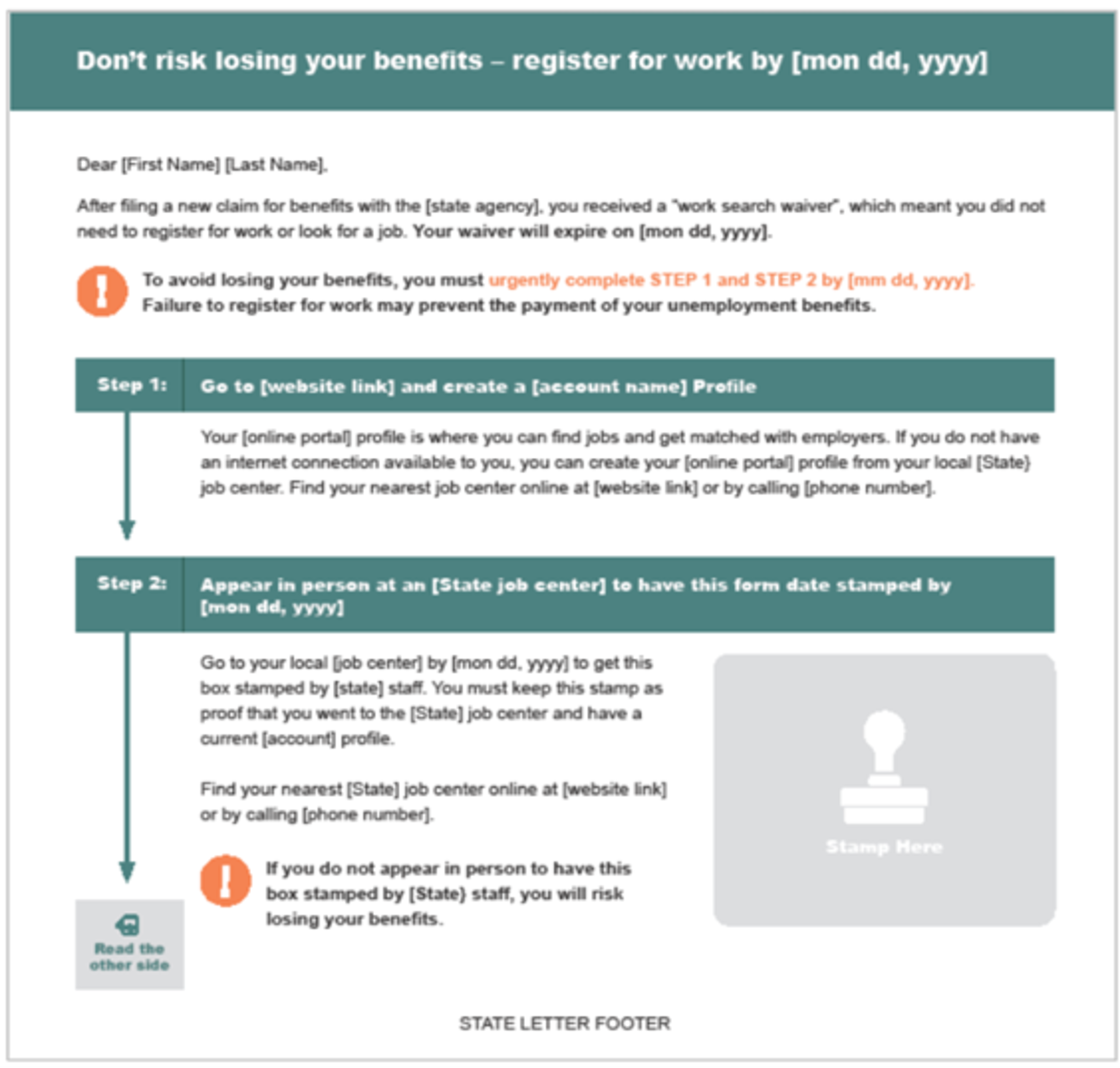
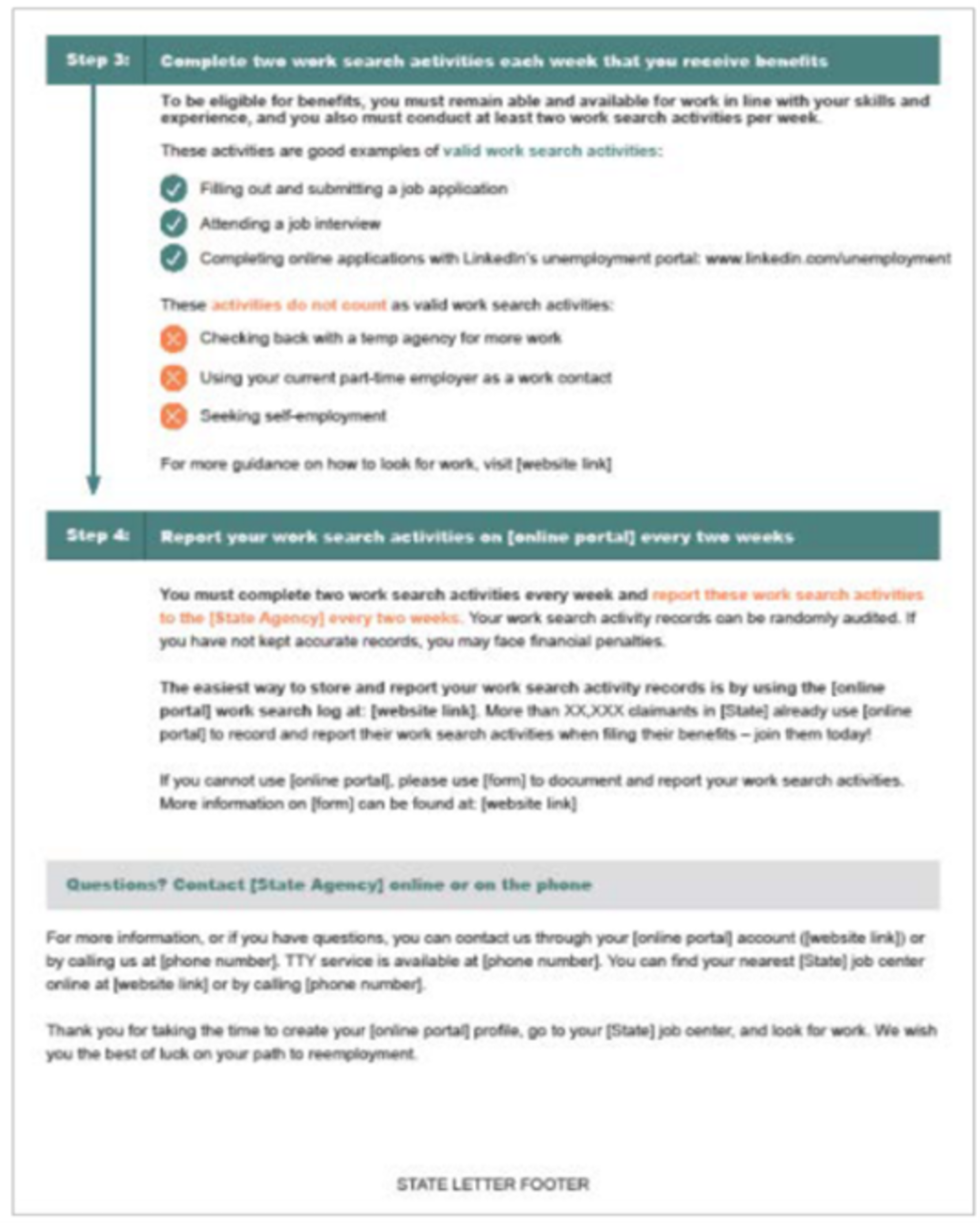
Below is an image of a final communications template. It includes a number of features that snap the comfortable habit of a work search waiver. In particular, it includes an urgent call to action, a defined checklist of the newly required routine, and attention-prompting visuals.
1. A “call to action” prompting claimants to start work search activities
Perhaps most importantly, the template adds a call to action with a clear penalty. “To avoid losing your benefits, you must urgently complete step 1 and step 2 by [ DATE ].” For state employees, waiver expiration can feel like a common status change, but for claimants, it can be a new and daunting process. Communicating with the appropriate tone helps people process the situation correctly. A sense of urgency focuses attention—helping claimants exclude other worries, prioritize important content, and prepare themselves for changes in behavior.
2. Clear steps on how to complete and report work search activities
Next, the document breaks the required actions into clear steps. Checklists are known for being clear and actionable. Here, a checklist makes it very apparent to claimants that they must create a profile, visit a job center, complete work search activities, and report them. In paragraph form, readers are more likely to miss an important step.
3. Adding complementary graphics to anticipate the message
Finally, the graphic design of the document underscores the most important elements. Rather than “pretty color,” think of graphic design like a score in film – it helps claimants think and understand information even before attending to other details. Functional graphic elements in this document include:
- Clear headings to help claimants mentally parse and prioritize content;
- Orange exclamations to emphasize urgent messages and penalties;
- Checks and exes to differentiate valid and invalid work search activities; and
- Arrows to direct claimants to read and complete all steps.
Work With Us
Our Behavioral Insights unit works with states interested in designing communications that help claimants meet work search and other requirements. Behaviorally-informed, scientifically-validated communication tricks—like urgency, checklists, and design—can support your state’s compliance goals. Email integrity@naswa.org to learn more.

The Behavioral Insights (BI) team applies behavioral science to help solve complex challenges facing the workforce system. By understanding how people make decisions, we can help improve compliance, reduce improper payments and streamline processes.
*A NASWA member login is required to access some Library resources. Watch this video for help.
This project is funded by the U.S. Department of Labor and administered by NASWA.