Getting Employment Separation Right: Designing for Accuracy, Not Assumptions
It’s a Monday morning in a state UI office. Your queue is full of flagged claims. Why can’t employers and claimants just report the same thing? You know each case requires investigation, delaying payments, and straining staff time. You also know most of these cases aren’t fraud. They’re simple misunderstandings rooted in how claimants interpret a single question: Why did your employment end?
Each of these small mismatches adds up, creating more work for staff and employers, and stress for claimants. It’s a familiar pattern in unemployment insurance programs, one that behavioral science can help explain and address.
Why Honest Mistakes Happen
While some claimants may be inclined to choose the option that will make them eligible for benefits, behavioral science helps us see that accuracy in reporting isn’t always just about honesty or dishonesty; it’s also about how people think under stress.
Claimants filing an initial claim are often under heavy cognitive load, trying to make sense of unfamiliar terms while worrying about rent or groceries. When faced with options like “discharge,” “voluntary quit,” or “lack of work,” many default to what feels closest rather than what’s technically correct.
Then there’s personal motivation. People naturally protect their self-image, especially in vulnerable moments. Choosing “fired” can feel harsh or self-blaming, so they lean toward softer language that aligns with how they want to see themselves. Emotional and practical motivations combine to influence reporting accuracy.
Finally, choice architecture, the way options appear on a screen, shapes decisions in subtle ways. When unclear or emotionally loaded options appear without guidance, claimants can unintentionally pick the wrong one.
Together, these forces create predictable patterns of error. They’re not always character flaws; they’re behavioral outcomes of complex systems.
Redesigning the Moment of Choice
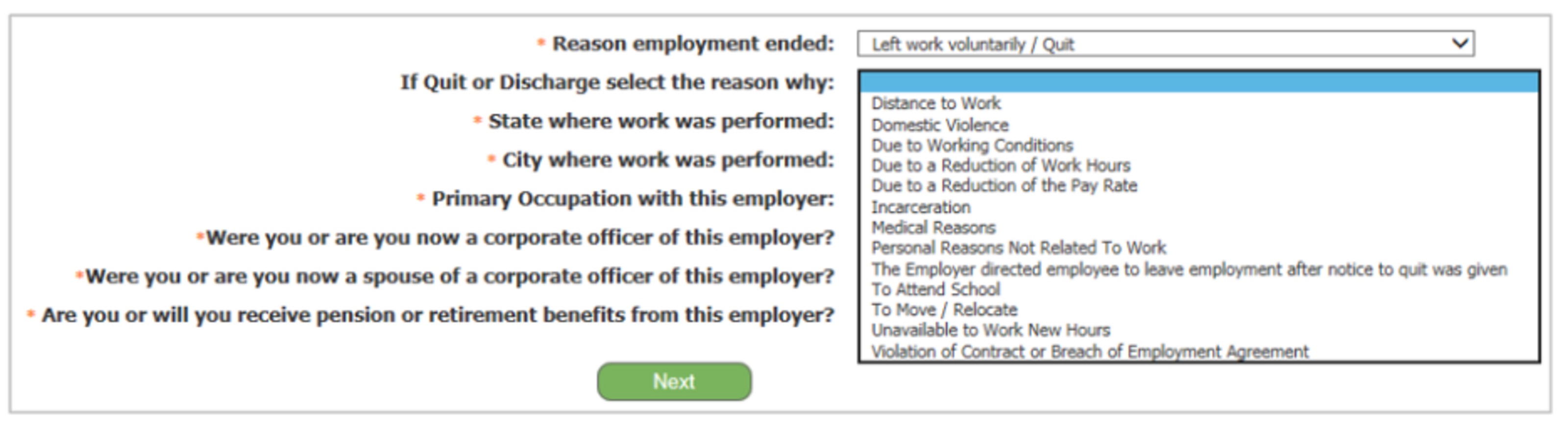
To address these avoidable errors, NASWA BI developed Messaging to Help Claimants Select the Most Accurate Separation Reason Intervention. The approach rethinks how separation options are worded and displayed in the initial claims process.
The revised design introduces several behavioral elements:
- Simplified language: Options replace legal or bureaucratic terms with plain, neutral wording like “My employer ended my job because I wasn’t meeting expectations” instead of “discharge for cause.”
- In-line guidance: Short help-text appears beside each option with examples (“If your employer said there wasn’t enough work, select layoff or lack of work”).
- Reordered options: The most common reasons appear at the top of the list, guiding users toward accuracy through design.
- Supportive tone: Definitions are written in a neutral language to reduce defensiveness and preserve personal motivation for truthfulness.
Prototype of revised separation language in the initial claim:
Program integrity begins the moment a claimant interacts with a system, not when an error is discovered. When systems anticipate how real people think and feel, they work better for everyone, claimants and staff alike.
Small Fixes for Increased Integrity
When claimants can clearly recognize their situation in the language presented, accuracy and efficiency improve. Fewer errors mean fewer adjudication problems, faster determinations, and fewer improper payments. The gains come not from more oversight, but from less confusion.
Even for agencies with legacy systems, this isn’t an all-or-nothing reform. Posting a brief FAQ that explains separation terms in plain language (which you can find here) or adding context boxes in the online initial claim can yield measurable improvements. Small design changes can prevent integrity headaches.

Reach out to NASWA BI
If you are interested in implementing these simplified separation reasons, NASWA BI can help. Reach out to us at integrity@naswa.org to learn more. And explore the Behavioral Insights Toolkit for examples, templates, and language samples your state can adapt.