Tools for Compliance: Employer Handbook
BI Beat articles often talk about strategies to help unemployment insurance (UI) claimants. For example, we recently wrote about our Claimant Handbook, which simplifies and prioritizes critical UI content for overwhelmed customers new to the UI system.
Of course, it takes more than one to tango, and employers also play an important role in UI. The failure of employers to effectively engage with the UI system — whether by not responding to requests for information or misreporting employee wages — contributed to 14% (or $4 billion) of improper payments last year. (2024 Improper Payment data).
To help employers take more accurate steps, NASWA produced a Model Employer Handbook. It helps employers:
- Learn their role in the UI program;
- Reference important information as the need arises;
- Feel motivated to participate in the UI program; and
- Remain compliant with requirements of the UI program.
Why a BI-Informed Employer Handbook?
Three NASWA teams (Learning and Library, State Engagement, and Behavioral Insights teams), helped design the Model Employer Handbook. Following a review of states’ existing handbooks, we worked to improve usability and employer engagement by incorporating principles of plain language, visual communication and behavioral design. The result is a shorter and carefully styled handbook that retains all critical information.
Three of the many behavioral strategies used to develop the Employer Handbook are highlighted below.
1. “Chunking” to make things easier to learn and reference
Despite its playful name, chunking very much hails from the academic literature, and you’ll come across quite a lot of it in the Model Employer Handbook. Our brains like to store similar information together, and the storage-and-retrieval process (i.e., remembering) is easier if similar information is found together.
In practice, chunking is a visual process. A few examples are:
- A clear table of contents
- Consistent headings and subheadings
- Consistent colors
- Icon sets for important categories
- Short paragraphs
- Delineated steps of key processes
All these items make the document scannable and memorable—critical features for a handbook of a complex system.
2. “Reciprocity” to encourage employer engagement
Reciprocity is another well-established tool from psychology research. People like working together – if you give to me, I’ll give to you; if I give to you, you’ll give to me. Many evolutionary psychologists link humanity’s success with our camaraderie and collaboration.
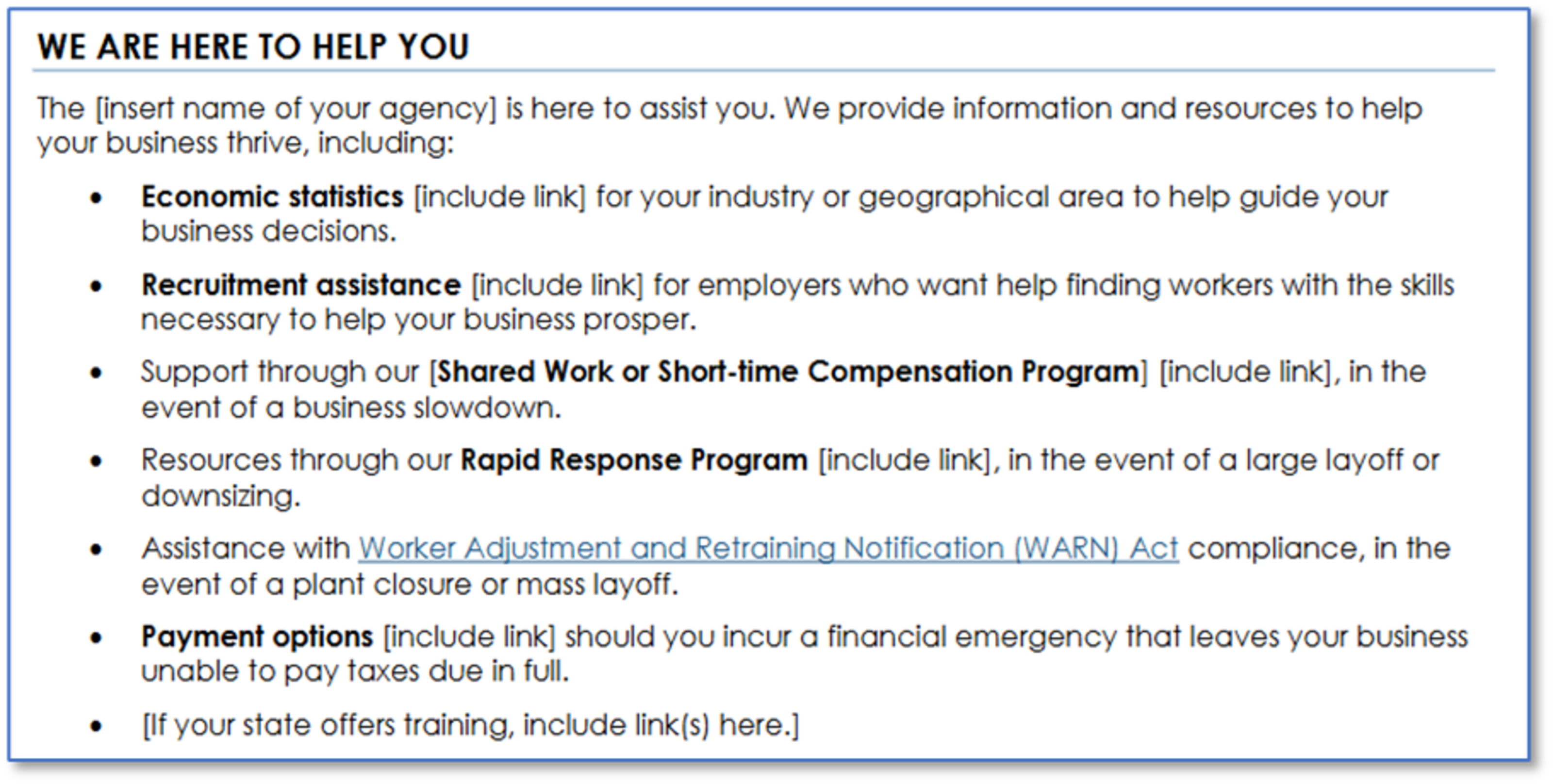
From the outset, the Model Employer Handbook establishes the relationship between employers and UI agencies as a partnership, reassuring employers that the state’s department of labor is a useful asset for them and the state economy overall. The introduction of the handbook (pictured at right) encourages states to specifically list the work they do for employers, thus building a sense of trust and mutual obligation.
3. Raising “salience” of penalties to encourage employer compliance
Much ink has been spilled among economists on how people respond to risks and rewards. One interesting finding is that our response to risk is very flexible and strongly influenced by our perception. For example, fewer people buy plane tickets after a well-publicized crash, even though the objective risk of flying has not changed.
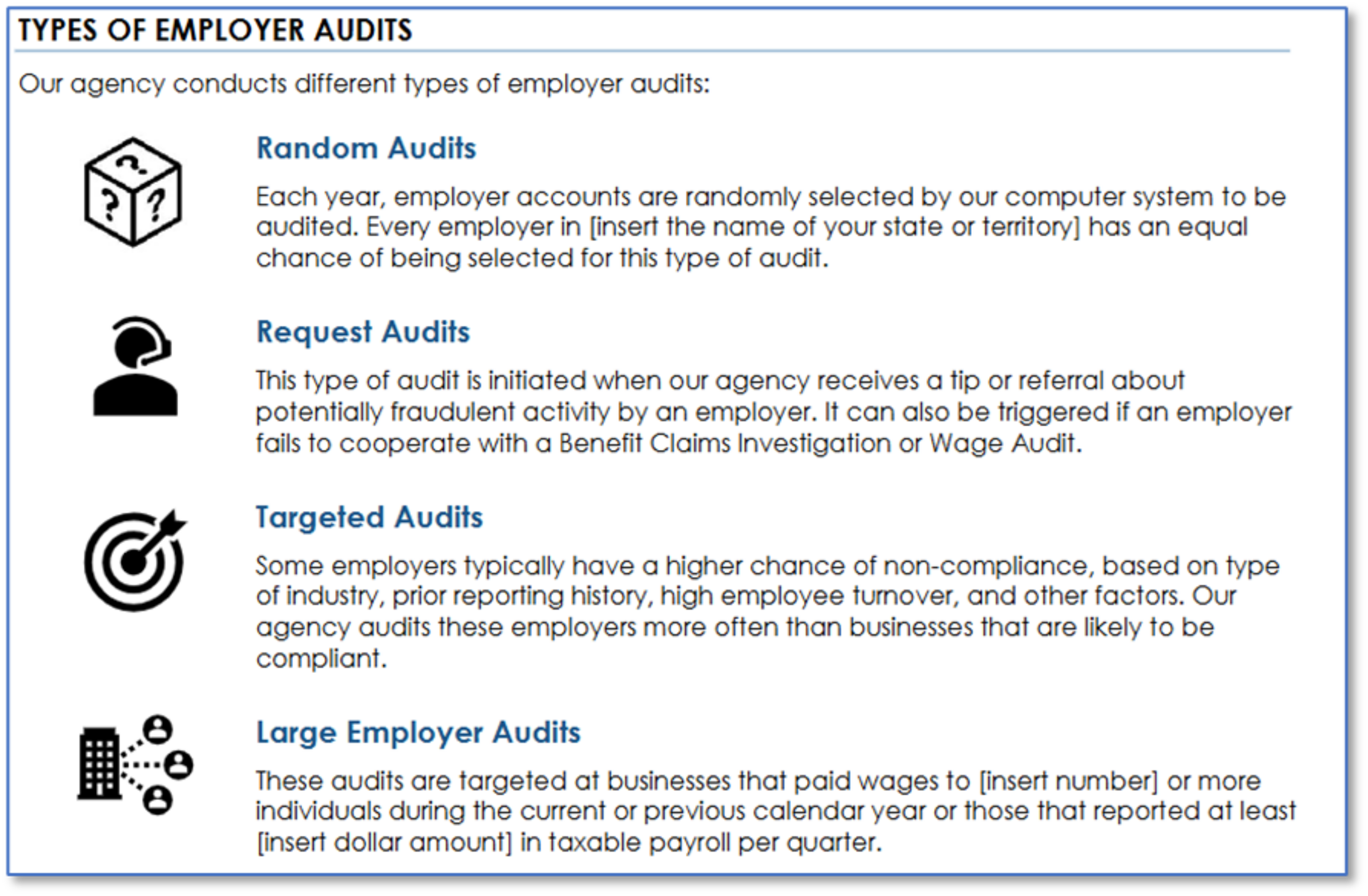
Features of the Employer Handbook make the risks of noncompliance feel more real to employers. For example, the handbook includes an eye-catching and in-depth discussion about audits (pictured below). Raising the “salience” of audits in this way can help the risk remain in people’s minds.
Greater Impact
The above represent only a few of the design decisions that went into the handbook. Quite a few more are featured within the Model Employer Handbook template* in the Library. The template can be downloaded and customized for states’ own use. Several states have used—or are using—this template to build more impactful employer handbooks.

Reach out to NASWA BI
If you are interested in improving your state’s employer handbook, NASWA BI can help. Reach out to us at integrity@naswa.org to learn more.
*The linked documents above require a Library login to access them. Watch this video for help.