Tools for Compliance: Claimant Video
In recent editions of the BI Beat, we have shared tools to help states improve communications and lower their improper payment rates, including a Model Claimant Handbook, a Model Employer Handbook, an earnings calculator, and a list of clarified separation reasons.* Today, we add another—one that should help your message stick in claimants’ minds.
Unemployment Insurance (UI) Claimant Video
In 2019, NASWA’s Learning and BI teams partnered with Deloitte to adapt a claimant video originally developed by a state to explain UI requirements. This line from our white paper on the implementation project sums it up well:
Narrated using an empathetic tone and illustrated with relatable, simple animation, the claimant video conveys the most critical information that claimants need to know in less than 5 minutes.
Sounds helpful, no? In fact, behavioral researchers have tested multimedia instructional materials and found that such videos help us learn because of intuitive features like visual representation, forced brevity, and vocalized tone.
A research paper titled “The Cognitive Theory of Multimedia Learning” demonstrates how people learn better when educational materials combine words and visuals. Our claimant video models a number of design features mentioned to help claimants understand, remember, and comply.
1. Animation and narration -- a two-pronged strategy
Video and animation are certainly more engaging than written text. Beyond getting people to pay attention, video formats actually help people learn by stimulating more of their brains.
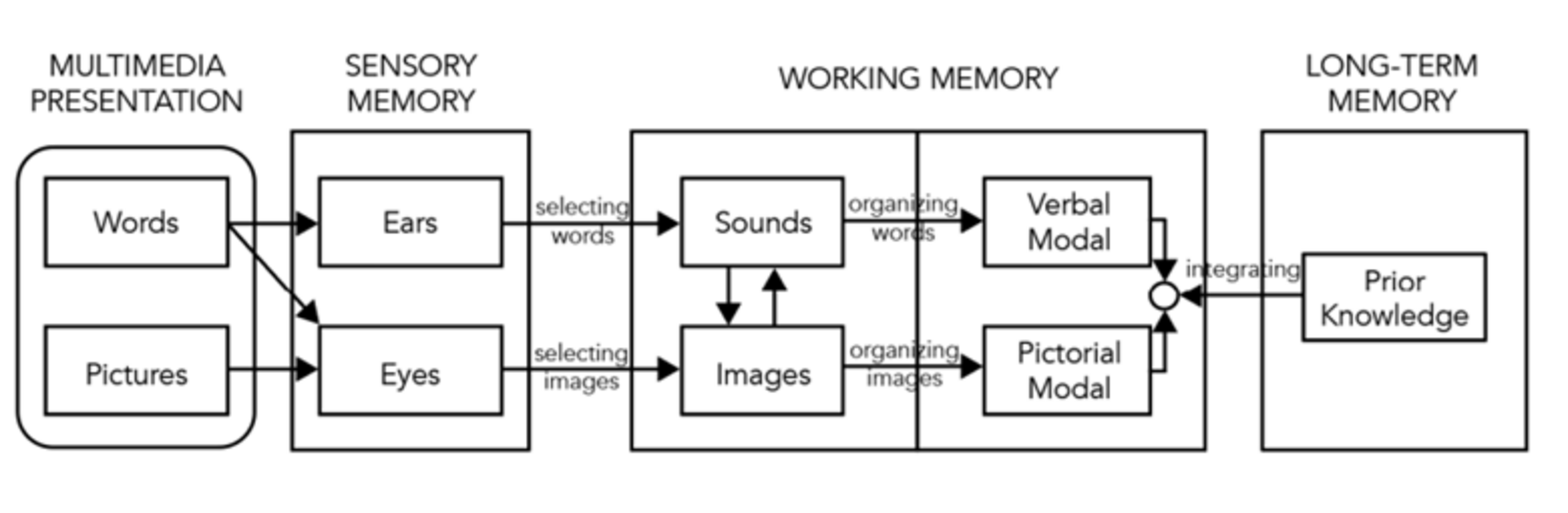
As the graphic above depicts, our brains ingest words and images through different systems. By using both, our video uses a two-pronged strategy to stick in claimants’ long-term memories. These types of multimedia presentations may be particularly effective for people who are under stress: such as parents who need to follow care instructions after their children’s emergency department visits, or those who have become unemployed. (Source)
2. Blueprint carefully before building
To learn, we use mental blueprints that psychologists call “mental models” or “schemata” to guide us as we piece together new bits of information. Yet, if these underlying blueprints have errors, what we piece together might not be accurate.
The claimant video outlines several concepts that may be improperly modeled in claimants’ heads. It sketches out what it means to:
- Collect unemployment insurance,
- Seek work (including documenting all activities), and
- Report earnings (including the difference between gross and net wages)
Equipped with accurate information, claimants can carry out their ongoing UI obligations as they journey from unemployment to reemployment.
3. Tone matters—be empathetic
Tone alone can reshape a learning experience. Many educators strive for a blend of welcoming and assertive, thereby giving learners the emotional space to learn while maintaining their trust and motivation. (See here for a longer discussion of why a balanced tone is an educator’s best friend.)
In the write-up on the video, we label this kind of tone as “empathetic,” and it accomplishes much. An empathetic tone encourages listeners to trust the speaker as a guide on complex topics, which is encouraging to claimants stressed by unemployment, and dissuasive to would-be fraudsters. This tone is appropriate for many claimant communications – feel free to adopt it yourself!
The upshot
More than a dozen state UI programs have implemented introductory videos for claimants based on NASWA’s model. In one state, we even evaluated how the video impacted new claimants. Comparing claimants who saw the video with those who did not (non-randomly assigned), we saw that claimants were more likely to:
- Report earnings when filing a claim (+3 percentage points)
- Understand they must report gross wages (+3 percentage points)
- Understand that they should document work search (+1 percentage point)
- Understand what they should document for their work searches (+2 percentage points)
By incorporating concepts from behavioral design and learning theory, we can help claimants properly engage with UI.
Reach out to NASWA BI
If you are interested in adding video to your state’s communications, NASWA BI and Learning can help. Reach out to us at integrity@naswa.org to learn more.
*A NASWA member login is required to access some Library resources. Watch this video for help.
Programs provided in partnership with the U.S. Department of Labor.